
From “What is the OSR?” to understanding its impact
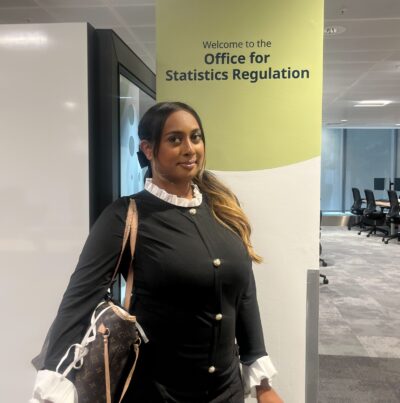
When I first received my Civil Service Fast Stream Summer Internship offer, I was ecstatic. After multiple application stages, a challenging interview and weeks of anticipation, I had finally secured a place.
But then I saw where I’d been placed: the Office for Statistics Regulation (OSR).
My first thought?
What even is the OSR?
Like many people, I was hoping for one of the larger government departments. The Department for Education, DEFRA or the Cabinet Office. Departments I had heard of and could easily explain to friends and family.
So, naturally, I did what many people my age would do.
“Hey Copilot, what is the OSR?”
A quick search later, and I learned that the OSR is the independent regulator of official statistics in the UK. It works to ensure that statistics serve the public good by promoting trustworthiness, quality and value, challenging the misuse of statistics and encouraging transparency in how evidence is communicated.
At the time, I wasn’t quite sure what that would mean in practice.
Now, after spending the summer here, I can safely say it has been one of the most interesting and rewarding experiences of my summer.
Joining a small organisation with a big purpose
As a working-class university student, entering the Civil Service can feel intimidating. There are often social perceptions that government can be difficult to navigate, highly bureaucratic or dominated by elitist educational backgrounds.
That wasn’t my experience at OSR.
From my first week, colleagues were welcoming, approachable and genuinely interested in helping me learn. Whether I was speaking to senior leaders, attending board discussions or having informal conversations with colleagues across the organisation, I always felt encouraged to ask questions and get involved.
One of the things I quickly came to appreciate about OSR is its size. Compared with many government organisations, it is relatively small, but that creates a collaborative and supportive environment. It never felt overly hierarchical or intimidating. Instead, people were approachable, willing to share their expertise and keen to help me make the most of my placement.
As an intern, that openness made a huge difference. It gave me opportunities to engage with a wide range of colleagues and gain insight into work across the organisation.
Learning about the public use of statistics and evidence
I was based in the Casework team, where I had the opportunity to shadow casework and learn more about OSR’s regulatory role.
Before joining OSR, I assumed regulation was largely about checking numbers and methodologies. What I learned is that it is often just as much about how statistics, data and wider analysis are used and communicated publicly.
One of the most valuable things I was introduced to was the Standards for the Public Use of Statistics, Data and Wider Analysis. These standards promote transparent, clear and appropriate use of evidence in public life, helping to ensure that statistics and analysis can be understood, scrutinised and trusted.
Through shadowing casework, I also saw the breadth of issues that can come to OSR. Cases often touch on current events, political debate, public announcements and claims made using statistics or wider analysis. What particularly stood out to me was how varied and fast-paced the work could be. Colleagues regularly had to get up to speed on complex issues quickly, exercise sound judgement and engage constructively with organisations across the statistical system.
Observing this work helped me develop a greater appreciation for the important role that regulation plays in promoting public confidence in evidence and ensuring that statistics genuinely serve the public good.
Looking beyond my own project
Alongside my placement in Casework, I had the opportunity to work on a lessons learned project looking at OSR’s activities during the 2026 elections.
This involved reviewing communications activity, analysing engagement data, facilitating focus groups and speaking with colleagues from across the organisation. Through this work, I was able to see how different teams contribute to OSR’s mission and how regulation, communications, research and stakeholder engagement come together to support public confidence in statistics.
The project also gave me the chance to develop skills that I will take forward into my future career, including research, stakeholder engagement, facilitation and communicating findings to different audiences.
Looking back
At the start of the summer, the Office for Statistics Regulation was an organisation I knew very little about.
A few months later, I leave with a much better understanding of the role statistics, data and wider analysis play in public life, the importance of transparency and public trust, and the work that goes on behind the scenes to uphold those principles.
Most importantly, I’ve had the opportunity to learn from supportive colleagues, gain experience in a unique part of the Civil Service and contribute to work that has a real impact on public confidence in evidence.
So, if you’re an incoming intern and find yourself placed somewhere you’ve never heard of before, my advice would be simple: keep an open mind.
The organisation you know the least about might end up teaching you the most.