
A Commitment to Trustworthiness, Quality and Value (TQV)
Society benefits from data and analysis produced by all kinds of organisations including the public sector, charities, academia, or commercial organisations.
The Code of Practice for Statistics (the Code), originally developed to set the standards for the production of official statistics by government, can support any organisation and analyst who works with or communicates data, statistics and analysis. The Code helps produce analytical outputs that are high quality, useful for supporting decisions, and that will be well respected. This is because the core principles of the Code – Trustworthiness, Quality and Value – provide a universal, ethical framework that supports analysis to be done in a way that supports public confidence and delivers for the public good.
Trustworthiness, Quality and Value benefit anyone producing data, statistics and analysis, whether they are inside or outside government. They are relevant to all kinds of data, such as those published in statistical research, economic analysis and management information.
The Office for Statistics Regulation (OSR), which maintains the Code, runs a scheme to recognise organisations working outside of official statistics production that voluntarily apply the Code. Producers of data, statistics or analysis that are not official statistics and who apply the Code principles are encouraged to be part of the TQV voluntary application (VA) scheme.
We encourage members of the scheme to be open and accountable in their application of the Code by publishing a statement explaining how they apply and meet the Code principles. Being part of the scheme reflects an ongoing commitment to apply TQV.
Building public confidence in statistics
The core principles of Trustworthiness, Quality and Value (TQV) describe the essence of what is required to ensure that the public can have confidence in data and statistics. They form the fundamental framework of the Code of Practice, the statutory code for official statistics produced by government bodies in the UK. They are underpinned by the Code principles, which unpack TQV to show the ten essential areas of practice.
The Code Principles:
Trustworthiness
1. Show integrity
2. Lead responsibly
3. Be transparent
4. Manage data responsibly
Quality
5. Prioritise quality
6. Be rigorous
7. Be open about quality
Value
8. Be relevant
9. Be clear
10. Be accessible
Why apply Trustworthiness, Quality and Value?
A commitment to Trustworthiness, Quality and Value offers the opportunity for an organisation to:
- Compare its processes, methods and outputs against the recognised standards in the Code that we expect of official statistics
- Build its reputation by demonstrating to the public and stakeholders its commitment to trustworthiness, quality and value
- Strengthen its practices by ‘thinking TQV’
- Encourage its staff to work towards a clearly defined standard that will ensure their data best serve the public good
For example, a commercial data organisation could show that it works to high professional standards in its data handling and analysis. A charity can use the principles to provide reassurance to its donors about its fundraising and public services. An academic body could use the Code to help ensure outputs from its innovative research resonate and can be understood by the public.
Making your commitment
Where an organisation chooses to adopt and apply TQV for all or some of its statistics or functions, we encourage it to publish a TQV statement. This statement should outline how the organisation or work area demonstrates practices in line with the Code. There are several stages that the organisation should work through.
1. Understand, review, consider
It is helpful to first understand TQV, the core principles of the Code, and to then review your approach to working with data and statistics in relation to TQV, and consider if there are ways of improving practice.
The VA cycle:
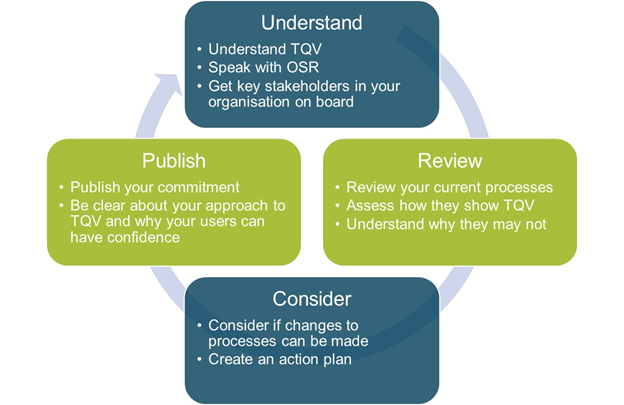
The diagram above displays the four areas of the voluntary application cycle:
- Understand TQV, speaking with OSR and getting key stakeholders on board
- Review your processes, assess how they show TQV and understand why they may not
- Consider if changes to processes can be made and create an action plan
- Publish your commitment, be clear about you approach to TQV and why users can have confidence
2. Think TQV
The key is to think about how you show the standards of Trustworthiness, Quality and Value in what you do. Ask yourselves:
- How are we trustworthy in the way that we are organised, and manage and use data?
- What is the quality of the data and how robust are our methods?
- How do we provide value by ensuring our information is useful and usable?
Use the Code principles as a guide. They provide a practical list of dos and don’ts to help steer your practice.
The Code of Practice also has the Standards for Official Statistics with a detailed list of standards and practices. These practices may be helpful to those organisations similarly publishing statistics which are useful to the public. See which standards are relevant to you and consider the detailed practices in your own work.
3. Be transparent and accountable: publish your commitment
The publish phase means being transparent. Transparency requires an organisation to make information available about why it thinks users can be reassured that it achieves Trustworthiness, Quality and Value. It is helpful to your users to be clear if there are aspects of the Code that are not applied, and to describe your approach to Trustworthiness, Quality and Value, referencing each of the ten Code principles.
The very process of opening up about working practices enables external scrutiny and responding to feedback is at the heart of building confidence. You will find it helpful to review OSR’s guide ‘Ensuring public accountability’ to find out more about how to provide reassurance to your stakeholders.
You can also look at the Standards for the Public Use of Statistics, Data and Wider Analysis in the Code of Practice to support public confidence when your organisation uses your analysis or data publicly.
4. Register of TQV Voluntary Application
OSR will add you to the online Register of TQV Voluntary Application when your TQV statement is published. The register includes a link to your published statement.
Your organisation can be added to the list reflecting an organisation-wide commitment to apply TQV. It is important to consider how you will embed the Code across your organisation.
You can also join the register for individual areas of work or outputs – most scheme members are of this kind.
While encouraged, publishing a TQV statement and being added to the Register of TQV Voluntary Application is entirely optional and at the discretion of the organisation. You can join the wider TQV community of practice (see below) without committing in a public statement.
Continuing to apply TQV
This is an ongoing commitment – not a one-off exercise. Continue to cycle through the process, reflecting on any changes that may affect your approach to the production and publication of statistics.
- Get senior buy-in to show that applying the Code matters to your organisation
- Develop an action plan to focus your efforts to improve practice in a proportionate and strategic way
- Embed the TQV principles within your teams and organisation
- Look for ways to promote the Code that are relevant to your organisation
- Share examples of good practice among your colleagues (see the further guidance section for more information)
- Join the TQV community of practice and attend our regular events and learning sessions
We recommend all organisations review their TQV Statement regularly. It can help to link your review to your organisation’s strategy or business plan. Tell your stakeholders about how you are developing within your TQV Statement, such as how you are extending your Code adherence or how you are developing the statistics.
Annual review
OSR will conduct a short annual review to check in with organisations on the Register of TQV Voluntary Application, asking them to confirm that they are continuing to apply TQV. This will be a good time to see what progress you have made on your action plan or check if you need to update your TQV Statement.
TQV Community of Practice
OSR supports a community of practice for anyone applying TQV or is interested in finding out more about what is involved. Sessions are run quarterly, involving members sharing their experiences and describing some of their work. Additional training sessions are arranged in response to the interests and needs of members, to assist them as they develop and embed TQV in their work areas.
OSR can also assist in arranging buddies for new members to learn from more experienced TQV practitioners.
How does OSR oversee the TQV VA scheme?
OSR is the UK Statistics Authority’s regulatory arm. Our remit focuses on official statistics produced by government, but we also encourage all producers of data and analysis to think about how to ensure that their potential benefit to society is realised.
We manage and apply the Code of Practice. Our role as regulator is to oversee the production and release of official statistics. We do not have a formal role in regulating the voluntary application of the TQV principles but we are responsible for managing the scheme.
If someone raises a concern with us that relates to the presentation of quantitative information in the public domain by a member of the TQV VA scheme, we will contact the organisation involved and review its TQV statement and procedures. Any intervention will be made on an informal and advisory basis. This work is carried out in line with our Interventions Policy. We are prepared to comment publicly on the voluntary application of the Code’s principles.
Further guidance
The Code of Practice website has a wide range of useful material that will help you apply TQV. It also includes a variety of links to useful resources about preparing statistics and handling data:
Code Guidance: information that supports use of the Code, including understanding and delivery of the principles and Standards, including short guides for the Code Principles, and individual guides for the ten areas of practice covered by the Standards for Official Statistics. Each guide includes links to examples from analysts and producers of statistics highlighting good practice
Understanding TQV: an introduction to the core principles of Trustworthiness, Quality and Value (TQV)
Code Principles: these ten principles explain how anyone working with data can put TQV into practice, in a wide range of settings
Standards for Official Statistics: these standards set out specific statistical practices for those producing official statistics and are useful guide for other statistical producers
Standards for the Public Use of Statistics, Data and Wider Analysis: these standards set out what public bodies need to do to ensure an open, clear and accessible approach to the publication and communication of statistics, data and wider analysis
Ensuring Public Accountability Guidance: Producers of statistics should see themselves as accountable to their users and can apply OSR’s guidance on accountability to provide reassurance about how they demonstrate Trustworthiness, Quality and Value
The next section provides further information about the three core principles, Trustworthiness, Quality and Value, and the ten Code principles that unpack them.
Back to top