

Findings
Achieved sample size
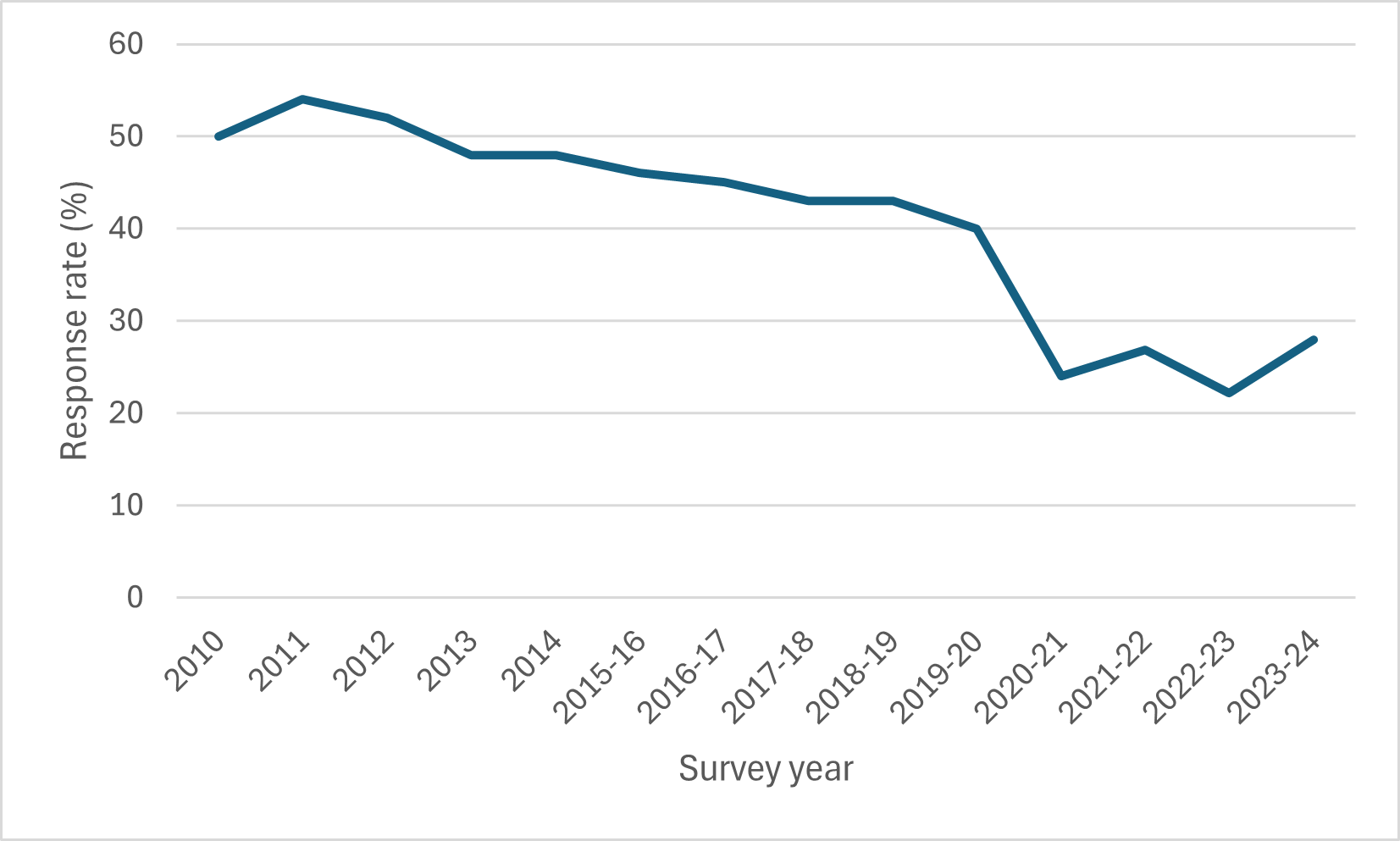
As is the case with other household surveys, the Living Costs and Food Survey (LCF) has seen a long-term decline in its response rates. This decline was exacerbated by the COVID-19 pandemic, as demonstrated by ONS in its published analysis of the impact of the pandemic on social survey data collection. As well as the face-to-face survey, a proportion of the respondents to the LCF are asked to complete a detailed diary of their spending habits over some time. This places an added burden on respondents, and so the LCF was significantly affected by the wider pattern of falling response rates in social surveys. As seen in the chart, the overall response rate for the LCF in Great Britain was 28 per cent in the financial year ending (FYE) 2024. This is a 6-percentage point increase in comparison with FYE 2023. This increase was driven by improved survey management, including enhanced respondent incentives and a targeted communications campaign to improve legitimacy and trust in ONS household surveys.
Chart 1. LCF response rates over time, Great Britain.
The achieved sample for the LCF in the FYE 2024 was approximately 4,200 households across the UK. This is a decrease compared to the approximately 4,500 responding households for FYE 2023, and below ONS’s ideal target of 6,000 households annually. ONS boosted the issued sample size in April 2024 and, with extra field resource, and as set out in ONS’s Survey Improvement and Enhancement Plan for Economic Statistics (SIEP), plans to include a further sample boost to dispatch the survey to 30,000 households in Great Britain from April 2026, subject to funding and the conclusion of current business planning processes. For comparison, ONS issued a sample of approximately 14,860 households across Great Britain for FYE 2024.
Users are concerned that the smaller sample sizes for recent outputs were making their analyses more volatile. To mitigate this, users have been combining data from several years to obtain the precision they needed for their estimates.
The annex to ONS’s Survey Improvement and Enhancement Plan for Economic Statistics notes that “On the LCF, alongside exploration of a digital diary, we are also developing a tool that can read receipts automatically, reducing the need for manual receipt coding. Future digital developments with the diary may improve underreporting, since a digital diary would be completed directly by the respondent without interviewer involvement. This may alleviate some of the unwillingness to share details of this type of spending”. These are important developments.
Back to topUser perspectives on meeting needs
We found that the Family Spending bulletin and the LCF microdata are valued by users, largely meet their needs and are unique in bringing together income and spending habits with information on the households who are doing the spending. This relationship is something that alternative sources do not tend to capture, as administrative sources of income and spending data do not have the same level of detail on household characteristics.
Data from the LCF have been published since the 1970s. Users value the long-running back series, using the data to inform key analyses such as:
- deriving weights for price indices, such as the Retail Prices Index, consumer price inflation and the Household Cost Indices
- including the LCF survey data within the suite of data sources used by ONS, to help compile gross domestic product (GDP)
- contributing to regional estimates of household expenditure
- informing monetary policy briefings
- contributing to the development of measures of poverty
- understanding the impact of inflation and taxation on household income and spending
- publishing official statistics about household dietary and drinking habits
Users are concerned that the sample size of the LCF means that more-granular estimates are less precise. ONS applies a 3-year average across several regional breakdowns in Family Spending, and this is communicated to users in the bulletin. ONS recognises that the number of household interviews is below their ideal target and has boosted the survey sample size from April 2024. Since the target for household interviews for Family Spending has not yet been achieved, ONS notes in its December update to the SIEP that it will “continue investing in LCF improvements as outlined in the SIEP, with earliest changes due from April 2026”.
In the interim, to increase the size of the datasets and precision of their estimates, users are merging datasets across two or three years. However, it is not straightforward to do this. Users told us that they found it difficult to merge microdata to boost the size of the dataset, because of definitional changes or discontinuities over the years. The LCF technical report FYE 2023 does not describe in detail how the methodology has changed prior to the current year. It does, however, direct users to the technical reports of relevant Family Spending years. To help users mitigate data quality issues, ONS should develop a timetable to provide more-accessible explanations of data changes, engaging with their expert users on what variables they are looking to merge by April 2026, and publish the timetable at the time of the next release.
Back to topTimeliness
The quality and methods information (QMI) published in 2023 notes that the “Annual datasets are made available approximately one year after the end of the survey cycle.” This timeline has drifted, however, and users we spoke to were concerned that the data were subject to a longer time lag. Data from 2022/2023 were published in August 2024, about 17 months following the close of the survey period. ONS told us that, in this year, updating the population data to provide the weights took longer than usual, but that the coherence between income and expenditure data improved as a result.
Users also told us that they experienced delays in being able to access the microdata. ONS told us that it is working with the data depositories and expediting depositing the microdata from the LCF survey in the Secure Research Service and the UK Data Archive.
ONS has increased the resourcing for the survey analysis team, and production of the statistics is becoming more automated, and faster. While this move has caused a short-term delay, it is ultimately expected to improve the timeliness of the 2026 release. However, the delays to data publication are significant and reduce the relevance of the outputs for users. It is important that ONS takes forward its planned improvements. ONS should set out, by April 2026, the steps it is taking to ensure that the speed up of the data processing delivers the Family Spending output closer to the target of one year after the close of the survey data collection period.
Back to topEngagement with users
Most of the users we spoke to were satisfied with the amount of routine and ad hoc engagement they had with ONS. For example, ONS holds quarterly ‘curiosity meetings’ for users involved in producing price index statistics and users involved in producing household expenditure statistics. For other expert users, ONS facilitates a household expenditure steering group meeting twice a year, where it presents any methodological changes or changes to the LCF questionnaire. ONS told us it is reviewing its arrangements for external engagement to align with the economic statistics plan and will provide an update on the new arrangements by March 2026. Some users felt that ONS could be more proactive in keeping them informed of developments between meetings, and other users told us that ONS had engaged quickly with them to answer detailed technical questions and requests for extra data.
Back to topCommunicating data quality
ONS published a technical report and associated LCF technical data tables alongside its Family Spending bulletin in September 2025. The report covers response information, questionnaire changes and new or changed methodology for the Living Costs and Food Survey (LCF) for the financial year ending (FYE) 2024. The LCF data tables provide information on response, characteristics of the sample, confidence intervals and interview metrics. ONS told us that, at the expenditure steering group meetings, it discusses difficulties with declining response rates and its plans to meet the challenges with expert users.
In August 2023, ONS published the latest quality and methodology information (QMI) report for the LCF. This includes helpful information about the strengths and limitations, methodology, users and uses for the LCF. The QMI discusses comparability with the Consumer Trends bulletin and notes that “LCF data feed into some of the estimates published in Consumer Trends, but other sources are also used. Research is ongoing into the different estimates produced and their causes”. The Family Spending bulletin cautions against comparisons by noting that “The expenditure statistics published in this bulletin are not directly comparable with the national income statistics published in our Average household income, UK bulletin”. The QMI and the bulletin should be clearer about which data should and should not be used as comparators for LCF estimates. Whilst ONS publishes details of the characteristics of households by response and non-response (LCF data tables 12 and 13), it has not published an analysis of the representativeness of the households in the sample. To enable users to understand the implications of the sample size on the quality of the data, and allow users to choose the best data for their needs, ONS should update the quality and methodology information and include explanations about survey bias, representativeness, comparability and implications for the use of the data by autumn 2026.
Back to topThe future of the LCF
To improve coherence between estimates, and the relevance of spending categories, ONS plans to introduce the 2018 COICOP classification into its data collection from July 2026. ONS told us that the LCF questionnaire will be updated first, to allow the survey data collection to lead the COICOP update. Economic statistics outputs will then adopt the COICOP changes afterwards. We welcome this development and encourage ONS to consider re-publishing a back series of the impacted outputs using the updated COICOP classifications. ONS has committed more investment into developing the LCF in the immediate term, as highlighted in the image below.
| Quality Targets | Living Costs and Food Survey |
|---|---|
| Achieved Interview Targets (March 2025) | 500 Households per month (requirement of 6000 annually) |
| Actual Achieved Interviews March 2025 | 367 households per month |
| Response Rate Achieved | 23% per month |
| User Needs | LCF sample increased in 2024, focus in 2025 to 2026 on sustainability and improving processing |
| Question or Survey Design | Survey and question design in need of review. Work in 2025 to 2026 to include critical SLC content and develop questionnaire |
Source: ONS Survey Improvement and Enhancement Plan for Economic Statistics annexes.
In the future, users would prefer a single dataset about wealth, income and spending because current data sources are fragmented, collected on different bases and cannot be easily linked. This makes it difficult to form a coherent picture of how these factors interact and influence each other. Users are also concerned that any face-to-face household survey design does not adequately capture the spending of high-net-worth individuals. In section 5 of its Survey Improvement and Enhancement Plan for Economic Statistics (SIEP), ONS is looking to develop a single dataset, noting “More broadly, we recognise that a new Household Financial Survey (HFS) design is required to ensure we can sustain financial survey collection in the future. This should be complemented by exploring the opportunities of both administrative data to replace survey questions, and online-first data collection. The development of HFS is currently unfunded but we aim to exploit opportunities during this forthcoming Spending Review (SR) period to conduct initial research, design and options analysis, with the aim of delivering a clear way forward ready for future SRs.” ONS is investigating supplementing survey data with administrative tax data, as detailed in its report titled The data that matter published in December 2025.
ONS published an update to its SIEP in December 2025. ONS provides the following update about the LCF: “We have successfully launched the Living Costs and Food Survey (LCF) Record of Spending tool, replacing the Excel diary used by interviewers to record detailed spending data provided by respondents”. ONS’s next steps include an evaluation of the benefits over the next six months, and exploring automation opportunities in receipt processing and coding as part of the wider LCF uplift. We note these developments.
Back to top