
If you’re looking for information on our recruitment journey, you’ve come to the right place. Whether you want to understand the steps in our application process, learn what we look for in successful candidates, explore how we conduct interviews, or discover what to expect during onboarding, simply navigate to the relevant section below.
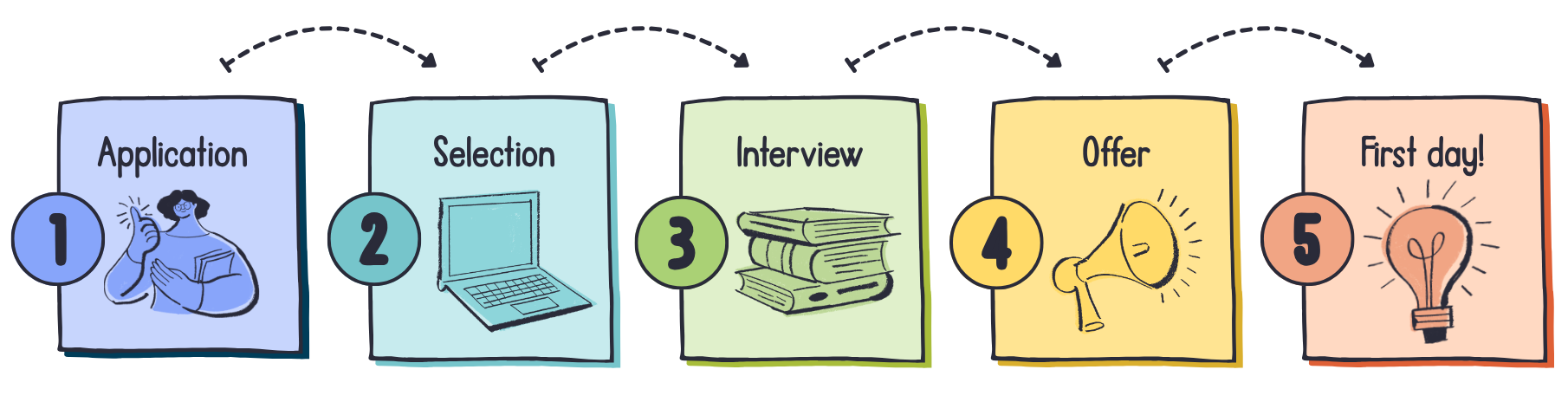
1. Application
Applying for a role at the Office for Statistics Regulation
You will find all applications for roles at the Office for Statistics Regulation (OSR) on the Civil Service Jobs website. When you apply for a role, it’s your opportunity to tell us about your work history, skills, experience and ability. We’ll be looking to see how the information in your CV and personal statement matches our advert.
We may also include some tests to help us choose the best people to interview. You can find more information about Civil Service online tests on the GOV.UK website.
Please note: The Office for Statistics Regulation is the independent regulatory arm of the UK Statistics Authority. Our recruitment support is provided by the wider UK Statistics Authority (UKSA), and so you may see branding and logos for UKSA in our adverts.
Reasonable adjustments to the application process
As part of our application process, we will ask you to let us know if you need us to make any reasonable adjustments for you. For example, you might need an extension of the closing date if you are a carer or have a cognitive impairment. You can contact the recruitment team using the contact details provided in the job advert, and we will do our best to meet any reasonable requests that we receive.
Disability confident scheme
We are a disability confident employer and encourage applications through the Disability Confident Scheme, where relevant.
This will allow us to support you in the best way through the application and assessment process.
You can find more information about the scheme on the GOV.UK website.
Writing a personal statement
A personal statement is the part of the application where you tell us about the skills and experience you have. This section should match up with the essential criteria part of the advert. When you’re writing a personal statement, you should:
- stick to the word limit but don’t be too brief – tell us why you’re the right person for the job
- treat each of the essential criteria like a question that your personal statement will answer
- read what’s required a few times, so that you completely understand it
- include in your answers what was needed, what you did and how you did it, what happened and what the outcome was
- write a first draft using MS Word, so you can check your spelling and grammar
- get someone to check that what you’ve written is clear and answers the questions
- give it one last read before you upload and submit it
Your personal statement should give us all the information we need to decide whether you’re a good fit for the role. If you are, we’ll invite you to an interview.
We recommend that you consider using the STAR method when completing your application, as it will help you to structure your examples according to the essential criteria.
2. Selection
What are Success Profiles?
An advert for a role at OSR might mention Success Profiles.
The Success Profiles framework is a system developed by the UK Civil Service to assess candidates for job roles based on their experience, behaviours, abilities, strengths and technical skills.
You can find out more about Success Profiles on the GOV.UK website.
Choosing the people that we will interview
When the deadline has passed on the Civil Service Jobs website, we will start to decide who we want to interview. We call this process sifting.
Depending on the role, we might also use a test or other type of assessment to help us choose. If this is the case, we will always mention the test or assessment in the job description.
A panel of colleagues at OSR will review a version of your application that has all your personal information removed.
They will compare the information in your application with the essential criteria in the job description and decide who we will interview.
3. The interview
The interview questions will focus on the information that we included in the role profile. We will ask some questions about your own past experiences and give you examples of situations to see how you would deal with them. There may also be a short presentation for you to prepare and deliver as part of the interview.
Interview hints and tips
A good interview requires excellent preparation, good listening skills and the ability to answer the question that is asked. Practice before the interview by preparing and rehearsing answers to possible questions.
Here are some useful tips.
- Try to arrange a ‘mock interview’ with your career centre
- Research OSR, what we do and who we work with
- Remember to apply the ‘STAR’ model when relating your examples to the questions
4. Offering someone a role at OSR
If you’re successful, we will contact you through your Civil Service Jobs account and call you on the phone to discuss your role.
Your offer will be based on the requirements set out in the job advert.
Sometimes, when we have more people that we’d like to offer the role to than we have posts to fill, we may put you on a reserve list. This means that if we have a similar role in the future, we may offer it to you without you having to apply and be interviewed again.
5. Your first day at OSR
Once you’ve accepted an offer, our onboarding team will guide you through the process. They’ll work with you to gather information that allows you to start as quickly as possible.
This can sometimes take a few months, as we need to organise security clearances and equipment. You may also have a notice period with a current employer that you need to complete.
We will keep you informed as things progress, and you will always have someone to contact if you need any help.