
In this blog, Ed Humpherson, Director General, and Job de Roij, Principal Statistics Regulator for our Crime, Education and Justice domain, look at how crime is measured, why public perceptions of crime can differ from the statistics, and what this means for responsible use of crime statistics.
Public debate about crime statistics often starts with a headline claim: crime is up, crime is down, one type of offence is rising, another is falling. Such claims need to be tested against the evidence. Sometimes headline claims can be misleading and misrepresent the statistical evidence. For example, OSR recently examined the headline claim that Northern Ireland is the most dangerous place to be a woman. But, as our statement shows, we couldn’t find any evidence to support it in the published statistics.
This matters to us. We aim to support public confidence in official statistics, and we recognise that this support depends on accurate figures, and on those figures being used honestly, carefully and in context. We are concerned that misleading claims can amplify fear and undermine confidence in crime statistics.
To understand how misrepresentation arises, and why crime statistics are often contested, it’s helpful to think in terms of three connected ideas: measurement; perception; and communication and use. Taken together, these ideas also help explain OSR’s role in supporting the appropriate use of crime statistics.
What’s being measured is complex
No single number or source captures the ‘true’ level of crime: every offence committed, every victim affected or every experience of harm.
Instead, what we know about crime comes from different data sources, each shaped by its own methods, definitions and limitations. In England and Wales, the two main data sources are police recorded crime and the Crime Survey for England and Wales (CSEW). Statistics from both sources are published by the Office for National Statistics (ONS). They are often treated as if they are competing versions of the same story. In reality, they offer different but complementary perspectives.
These two sources measure crime differently and cover different populations and crime types. Police recorded crime figures reflect offences reported to and recorded by police. They tell us about offences known to the police and the demand on the criminal justice system. In contrast, the CSEW is a household survey that asks a sample of people about their experiences of crime, including incidents that were never reported to police. That makes the CSEW estimates valuable for understanding patterns in experiences of crime in the general population, and for tracking long-term changes in many crime types. Last year we published a statement about these two crime data sources, highlighting their strengths and limitations.
Because no one source gives a complete picture, we need to understand what each measure can and can’t tell us.
Perceptions matter
Perceptions also play an important role in debates about crime. Sometimes, people’s perceptions of crime don’t align neatly with the statistics.
Bobby Duffy (then of IPSOS-Mori, now of the Kings Policy Institute) explored the mismatch between people’s perceptions and statistical evidence in his book ‘the Perils of Perception’. It provides examples, from across the world, of how perceptions and reality can diverge, and explains how these misperceptions arise.
It has long been recognised that the public’s perception of crime is shaped not only by statistics but also by direct experience of crime, conversations with others, media reporting, political rhetoric and broader social anxieties. High-profile incidents, such as a homicide or knife crime incident, can shape collective perceptions far more strongly than their frequency might suggest. These incidents are serious and can strongly shape how people think about crime. And, because they are widely reported at the national level, people may reasonably feel that such crimes are more common than the statistics suggest. For a host of reasons, people may reasonably feel that crime is becoming worse because of what they see, hear and fear, even where some statistical measures tell a different story.
ONS’s statistics illustrate this point clearly. The CSEW consistently finds that the majority of people think that crime has gone up ‘a little’ or ‘a lot’ in the past few years in England and Wales, even though there has been a long-term decline in CSEW headline crime (Figure 1). (Here we have used the estimate of CSEW headline crime excluding fraud and computer misuse as the CSEW only started measuring fraud and computer misuse crimes in 2017.)
Figure 1: CSEW headline crime and perception of crime in England and Wales, year ending (YE) March 2010 to YE March 2026
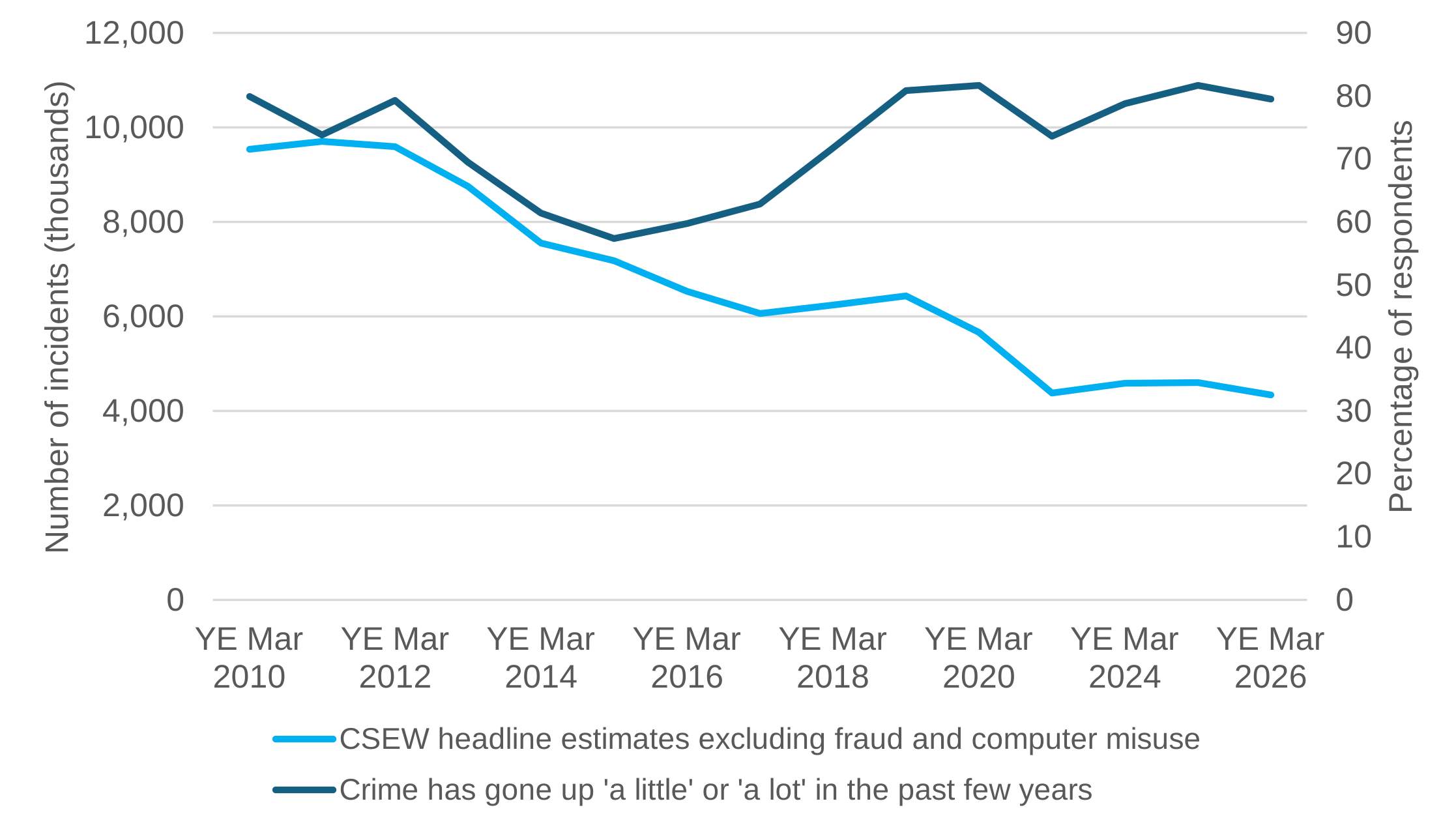
Source: ONS Crime in England and Wales: Appendix data tables, Table A1A (CSEW headline crime); ONS Crime in England and Wales: Annual supplementary tables, Table B1 (crime perception).
The gap between perceptions of crime and statistical evidence shouldn’t simply be treated as a problem of public misunderstanding. People’s concerns about crime are real, even when the statistics present a different picture. It’s more helpful to recognise the gap and communicate the evidence in ways that are sensitive to this.
Statistics can be misused
The problem arises when statistics are misstated to reinforce perceptions, or when perceptions are translated into statistical claims that the evidence doesn’t support.
This can happen in two ways: first, undue weight can be put on an individual crime type, despite the complexity of measuring crime. Looking at individual crime types can be useful, but only when they are presented in context and not used to infer broader trends in crime. The second happens when claims are made that are not based on any statistical evidence.
Take the current debate about crime in London. There is a perception that crime in London is high and rising. Some claims rely on individual crime types to endorse this perception. But the statistical picture is mixed. ONS’s Police Force Area data tables (Table P2) show that the number of homicides, knife-enabled crimes and robbery offences recorded by the Metropolitan Police fell between the year ending March 2025 and the year ending March 2026, while other crime types, such as violence without injury and possession of weapons offences, increased over the same period.
On this basis, broad claims that crime in London is rising sharply are not supported by the statistics.
Such patterns are not unique to London. Population size needs to be taken into account when comparing police force areas. For instance, the Metropolitan Police record more knife-enabled crime than any other police force because it covers the largest population. The Police Force Area data tables (Table P3) show that the rate of police recorded crime per 1,000 population in London (101.0 for the year ending March 2026) is broadly comparable to other police forces that cover large urban areas like Greater Manchester Police (103.7) and West Midlands Police (99.0).
It’s important to communicate statistics effectively
What can producers of statistics do in this environment?
They have a responsibility to explain their statistics well. Reporting the figures is only part of the task. They must also anticipate how those figures might be misinterpreted or misused and be clear about the limitations of the statistics and what the statistics can and can’t be used for.
ONS already does this well for its crime statistics. For example, the Crime in England and Wales publication contains clear and prominent caveats about how police recorded crime figures are affected by improvements to recording practices and are not always a good indicator of trends in crime. It also explains which crime types are not included in the CSEW headline crime estimate and which populations are not covered by the survey.
But there is more that ONS can do to minimise the risk of misuse. We understand that ONS is considering adding a table of dos and don’ts to the publication. This type of table would make the guidance easier to use and give people a clearer basis for recognising when a claim goes beyond what the statistics support.
Users of statistics, including politicians, commentators and others, also have a responsibility to avoid making claims that go beyond the statistical evidence and respect the limitations of the statistics. Our Standards for the Public Use of Statistics, Data and Wider Analysis set out how this can be done.
OSR’s role in supporting appropriate use
As the UK’s statistics regulator, our aim is to support the appropriate use of official statistics by challenging claims that mispresent what the statistics show or go beyond the evidence. Our role is not to criticise or minimise public concern about crime.
For example, earlier this year we published a statement to clarify several common misunderstandings about statistics from the CSEW, including that the CSEW estimates are unreliable, the CSEW sample is not representative, and CSEW estimates are less accurate than police recorded crime figures. In each case, we found clear evidence that challenged the misunderstanding and showed why the CSEW remains a valuable source for understanding crime in England and Wales. We did the same when we looked at the claims about women’s safety in Northern Ireland referred to in the opening paragraph of this article.
We also call out misuse directly, publishing public letters or statements when we think crime statistics have been used in a misleading way or without appropriate context. For example, in 2022 we challenged the use of crime statistics by the Prime Minister, Home Secretary and the Home Office. They did not make it clear that they were citing CSEW estimates excluding fraud and computer misuse, which gave a more positive picture of short-term crime trends.
But we recognise that there is more we could have done to challenge misunderstanding and misuse in recent years. In writing this blog, we want to signal that we are more willing to step in when this happens.
To conclude, crime is difficult to measure, and public perceptions are shaped by more than statistics. That creates a risk that statistics are used selectively or inaccurately to support claims the evidence does not bear.
When that happens, the public can be misled and trust in official statistics can be undermined. OSR’s role is to ensure that producers communicate their statistics clearly and effectively, challenge misunderstanding, and step in when statistics are used inaccurately or unfairly.