

Quality and resilience of statistics
Over the past year, the quality and resilience of statistics have remained under pressure, although there has been improvement in some areas. This section shows that the Office for National Statistics (ONS) has made progress in improving some economic statistics and in stabilising parts of its survey portfolio. It also shows that important challenges remain for the wider system, including continuing concerns about survey response and representativeness, weaker confidence in some subnational population estimates, and the effect that quality problems in key sources can have on other statistics.
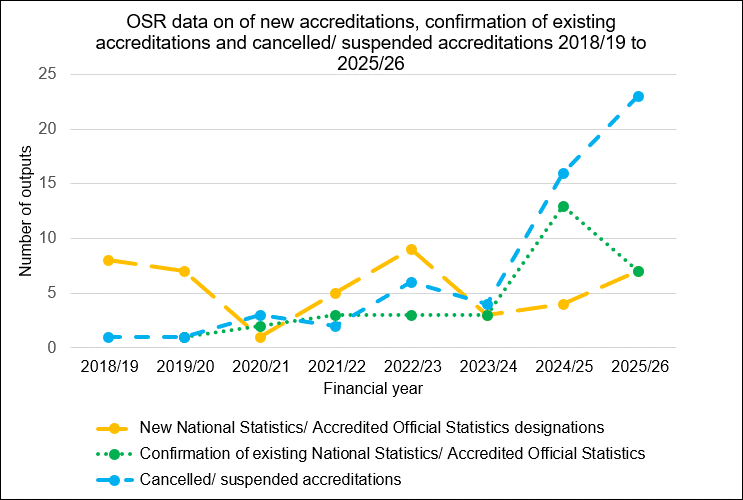
The increase in suspensions and cancellations of accredited official statistics over the past two years shows that accreditation is being used to signal to users where statistics do not currently meet the standards of the Code. At the same time, new accreditations and confirmations have continued, showing that accreditation remains an active part of the regulatory framework.
Economic statistics
Concerns about the quality and reliability of ONS economic statistics have remained a major focus of OSR’s regulatory work over the past year. In response to issues identified through our April 2025 interim systemic review and November 2025 final review, ONS published its Plan for ONS Economic Statistics and Survey Improvement and Enhancement Plan, and has since begun publishing quarterly progress updates. OSR has responded publicly to those updates as part of its ongoing regulatory scrutiny.
In our January 2026 response to ONS’s first quarterly update, we judged that ONS was meeting the immediate requirements set out in the interim and final reports of our systemic review. We also made three further recommendations to improve the transparency of future reporting, including stronger user focus, more disaggregated cost information, and further reporting on quality reviews, recruitment and retention, and legacy systems.
In our May 2026 response to ONS’s second quarterly update, we noted that the latest update demonstrated genuine and welcome progress. We welcomed signs of stabilisation, greater transparency, stronger governance and more proactive engagement with users. At the same time, we noted that critical challenges and risks remained, particularly in relation to sustaining quality, delivering the Transformed Labour Force Survey, implementing the new Statistical Business Register and improving response rates across social surveys. The Statistical Business Register remains a significant dependency for ONS’s plans for improving economic statistics, and delays to its implementation continue to present a delivery risk. This is not a new issue. Replacing the current register has been a long-running dependency for transforming economic statistics.
We also noted in our response that these ongoing risks and challenges were reflected in delivery, with over one-quarter of the milestones scheduled for delivery in 2025/26 delayed. This may indicate that the original plans for economic statistics were in part over-ambitious and unrealistic. It underlines the importance of realistic planning, clear prioritisation and transparent reporting where delivery is under pressure. ONS’s structured “waiting room” approach should help support planning and clearer prioritisation, but its impact will need to be demonstrated through delivery.
Surveys
Last year, we commented that challenges with household survey response rates were becoming particularly significant, especially in ONS surveys. Since then, interventions by producers have contributed to improvements in achieved sample sizes and response patterns in particular surveys. However, survey response and representativeness remain significant challenges, and concerns about data quality continue to impact many areas of the statistical system.
The most visible survey challenges during the year were in relation to the ONS Labour Force Survey (LFS), the main household survey used to produce official estimates of the UK labour market. In 2023, declining survey response rates led to significant quality concerns about LFS-based estimates. In November 2023, OSR removed the accredited official statistics status of ONS’s LFS-based estimates and datasets. In December 2024, OSR also highlighted that the quality issues with the LFS had affected outputs across and beyond ONS, including a wider set of LFS-derived and Annual Population Survey (APS)-derived outputs.
ONS has since taken substantial action to stabilise the survey while continuing to develop the Transformed Labour Force Survey (TLFS). This has been followed by clear improvement in the operational position of the survey. ONS reported that the overall response rate for January to March 2025 was 21.3%, up from 12.7% in July to September 2023, and that response levels by late 2025 were close to their pre-pandemic levels across all waves.
However, recovery is not complete. In its April 2026 update, ONS continued to advise caution when assessing change over time periods affected by operational changes and when analysing more-detailed estimates. In our April 2026 update report, we found that the survey did not yet support more-detailed regional or devolved analysis.
As we were finalising this report, ONS announced that an operational error had reduced the number of telephone interviewers allocated to the LFS in May and June. This reduced achieved household interviews on waves 2-5 of the main sample by around 1,200, or 19%, compared with the preceding period. ONS has said this will temporarily reduce the quality of labour market statistics published in July, with a smaller effect on later releases. ONS has set out immediate actions and set in train a lessons learned exercise which will have external input. The steps ONS has set out will be important to assure quality and confidence in this priority area.
A devolved perspective shows how producers are responding differently to survey pressures. The Scottish Government has communicated with users about changes to labour market statistics in Scotland. It explained the decision to end funding for the Scottish LFS boost and the expected impact on APS-derived estimates, while setting out plans to explore alternative data sources, including administrative financial data.
Although response rates in Northern Ireland have not declined as much as other GB surveys, the Northern Ireland Statistics and Research Agency (NISRA) chose to develop a shorter Labour Market Survey. NISRA’s focus was on key labour market indicators for Northern Ireland stakeholders, removing content that was not used or was available from other sources, and maximising response rates and the quality of responses. In our 2026 compliance review, we found that NISRA had taken a considered approach, balancing response rates, data quality considerations and user needs. ONS and NISRA are working closely together to deliver cohesive UK-level estimates. It is vital that this collaboration continues, particularly in the context of high-profile labour market statistics. However, the transition to two new surveys with different timelines and some differing content presents ongoing challenges for both producers.
In June 2025, following concerns raised through our review of ONS economic statistics and the wider context of the Independent Review by Sir Robert Devereux KCB, ONS published its Survey Improvement and Enhancement Plan (SIEP), which set out an ambitious plan to restore confidence in ONS’s survey operations, data quality and systems.
ONS has since provided regular updates on this work, most recently in April 2026. These updates show progress in some areas, particularly on the Labour Force Survey, but also illustrate that important risks remain. Our systemic review also flagged risks around the quality of business surveys. ONS’s updates describe work to improve engagement with businesses and reduce reporting burden. They also report progress in moving some collections away from legacy systems. At the same time, ONS has reported continuing delivery challenges, including in relation to the Statistical Business Register and the sequencing of wider survey improvement work. These remain important dependencies for wider economic statistics improvement.
Other producers have also introduced changes intended to mitigate declining response rates and protect data quality. For example, to improve the accuracy of benefit amounts in its survey, the Department for Work and Pensions (DWP) is transforming the Family Resources Survey through the use of administrative benefits data, while the Department for Culture, Media and Sport (DCMS) has introduced a more modular and adaptive approach through its new Community and Engagement Survey. Other surveys, including ONS’s Annual Survey of Hours and Earnings, have moved toward “digital by default” collection, with the aim of improving respondent convenience and submission rates. These changes may improve quality over time, but they can also create uncertainty for users while methods and outputs evolve. Producers need to explain these changes clearly to users and work together where changes to survey sources affect related outputs.
However, as Annex A shows, response rates across many surveys remain below historic levels, which continues to raise concerns about representativeness and the quality of outputs that rely on survey-based data collection. Improvements in achieved sample sizes can help strengthen the stability of survey estimates, but they do not on their own resolve concerns about quality if the responding sample is not sufficiently representative of the wider population. These issues are not confined to a single survey or producer. In cases where lower response rates have increased reliance on weighting adjustments and modelling, we have recommended that producers place greater importance on transparency around uncertainty and data limitations. We also recognise that, whilst response rates are important, they are not the only factor affecting data quality.
The Scottish Government has also taken work forward to understand the causes of survey nonresponse. Research commissioned by the Scottish Government, with funding support from ONS, examined nonresponse in the Scottish Household Survey, Scottish Health Survey and Scottish Crime and Justice Survey. It found that some groups were less well represented in these surveys, including younger people, people living in deprived areas, people from minority ethnic backgrounds and private renters. The research identified barriers to participation and actions that could be tested to make surveys easier to take part in and more relevant to respondents.
Against this backdrop, survey mandation (a legal requirement to participate in a survey) is receiving increased attention in parts of the statistical system. This issue was also highlighted in the Independent Review of the UK Statistics Authority by Professor Denise Lievesley, which recommended that the UK Statistics Authority engage with the Cabinet Office to explore the consequences of mandatory completion of the Labour Force Survey. In its December 2025 update to the Survey Improvement and Enhancement Plan, ONS noted that work was underway with the Cabinet Office and HM Treasury on a “state of play” paper, with recommendations for further exploration of non-statutory approaches and future discussion of mandation. This means mandation has been recognised as a relevant issue, but there has not yet been a clear public position on whether, or how, it should form part of the longer-term response to survey quality challenges.
There has been some improvement in survey-based data collection where producers have prioritised targeted recovery activity. However, the persistence of response and representativeness challenges shows that significant underlying risks to quality remain. The longer-term challenge is not only to recover individual surveys, but to develop survey strategies that can continue to meet user needs as response patterns and data sources change. This builds on our recommendation last year that the statistical system should better understand variation in survey response rates and develop system-wide solutions. This year, our regulatory work shows the importance of giving users a clearer view of what survey quality means in practice, including where quality is affected for particular geographies, subgroups or uses.
 Recommendation

The National Statistician should ensure that public reporting on key household and business surveys gives users a clear explanation of survey quality, so they can understand what the estimates can support and where the evidence is not strong enough for particular uses. This should include achieved sample sizes, response rates and representativeness, and explain where survey quality limits the use of estimates for particular geographic areas, population groups or types of analysis.
Measuring the population in the UK
Population statistics remain a fundamental component of the UK statistical system, underpinning a wide range of economic, social and administrative statistics. Alongside the 10-year benchmark provided by the censuses, population estimates are used extensively to inform policy development, allocate resources and support service planning across central and local government. The importance of these statistics means that confidence in their quality and coherence is critical for the functioning of the wider system.
Over the past year, the population statistics system has operated in a context of significant change and uncertainty. Across the UK, producers are making increasing use of administrative data sources to improve population and migration statistics, with the aim of reducing reliance on traditional approaches. These developments offer clear opportunities but also introduce additional methodological complexity and uncertainty, particularly where data sources were not originally designed for statistical purposes.
Within this evolving landscape, our regulatory work highlights that population statistics continue to provide broadly credible insights at a national UK level. The combination of census data, surveys and administrative sources provides a strong basis for understanding long-term demographic trends. At the same time, there remain important challenges in producing robust estimates at a subnational level in some parts of the UK. In particular, local authority areas in England and Wales with high levels of migration or population churn, and groups such as students, continue to present difficulties for estimation approaches that rely on integrating multiple data sources. These challenges can lead to differences between statistical estimates and local intelligence, contributing to varying levels of user confidence.
Our recent compliance review of mid-year population estimates for England and Wales illustrates these issues clearly. While these estimates remain a valued and widely used source of population data, we identified concerns about the quality of some local authority estimates and the need for clearer communication of uncertainty and limitations. Strengthening transparency, improving engagement with users and providing clearer guidance on appropriate use will therefore be essential to maintaining confidence in population statistics and supporting their effective use across the system in England and Wales. Later in the year, we plan to review mid-year population estimates in Scotland and Northern Ireland so that we have a UK-wide position and view of these statistics.
Decisions about the future approach to population statistics have also shaped the system over the past year. Following consideration of administrative-based approaches, ONS decided not to move to admin-based population estimates as the headline measure for England and Wales at this stage, and instead to continue with mid-year estimates while pursuing a programme of improvement. This decision places renewed emphasis on the quality, coherence and communication of existing estimates, as well as on ensuring that learning from the development of administrative-based methods is retained and applied.
At the same time, preparations for the 2031 census are underway across the UK. Confirmation that censuses will take place in 2031 has provided greater clarity for producers and users, although the timing of the decision has introduced additional pressures for planning and delivery. The return of the Population Statistics System Committee has provided a clearer route for co-ordination between the census offices as they develop recommendations and prepare for census testing. The next census will draw more extensively on administrative data and integrated data systems, reflecting a broader shift in the statistical system. However, current evidence indicates that administrative sources do not yet provide sufficient coverage or consistency to replace the census entirely, reinforcing the continued importance of a mixed-methods approach.
Experience from the 2021 and 2022 censuses provides important lessons for the future. Despite the challenges posed by the COVID-19 pandemic, producers delivered high-quality and accessible outputs overall. In some cases, such as in National Records of Scotland (NRS)’s 2022 census outputs, innovative use of administrative data, combined with strong communication and transparency about uncertainty, helped maintain user confidence even where there were operational challenges. These experiences show that technical capability and clear communication are important for maintaining confidence in population statistics.
Looking ahead, achieving greater coherence across the UK population statistics system will remain an important priority. While there have been improvements in collaboration and engagement between producers, continued leadership attention will be needed to ensure that approaches are aligned and that learning is shared effectively across the four nations.
Overall, population statistics continue to provide an essential foundation for the UK statistical system. The move towards greater use of administrative data, alongside challenges in subnational estimation, means producers will need to continue explaining quality and uncertainty clearly to users. Continued UK-wide co-ordination will also be important as decisions about future methods and data sources develop.
Trends in de-accreditations
Accredited official statistics are official statistics that have been independently reviewed by OSR and confirmed to comply with the standards of Trustworthiness, Quality and Value in the Code of Practice for Statistics. Accreditation can be suspended or cancelled where substantial non-compliance with the Code is identified. Changes to methods, data sources or producers do not automatically mean that accreditation should be removed. Removal is needed only if those changes affect compliance with the Code. OSR’s concerns are greatest where users could be materially misled by statistics that continue to carry accreditation.
An increase in suspensions and cancellations is in some ways an indication of the health of the statistical system. It shows that OSR, as the system regulator, and statistics producers themselves, take the Code seriously and use accreditation to give signals to users where statistics do not currently meet the standards of the Code.
Over the past two years, there has been a marked increase in suspensions and cancellations of accredited official statistics. Our metrics on cancelled and suspended accreditations (Figure 1) show that the number rose from 4 in 2023/24 to 16 in 2024/25, and to 23 in 2025/26.
Figure 1. OSR data on new accreditations, confirmations of accreditations and cancelled/suspended accreditations
| 2018/19 | 2019/20 | 2020/21 | 2021/22 | 2022/23 | 2023/24 | 2024/25 | 2025/26 | |
|---|---|---|---|---|---|---|---|---|
| New National Statistics/Accredited Official Statistics designations | 8 | 7 | 1 | 5 | 9 | 3 | 4 | 7 |
| Confirmation of existing National Statistics/ Accredited Official Statistics | 1 | 2 | 3 | 3 | 3 | 13 | 7 | |
| Cancelled/suspended accreditations | 1 | 1 | 3 | 2 | 6 | 4 | 16 | 23 |
The increase in 2024/25 was driven overwhelmingly by the widespread use of the Labour Force Survey (LFS) and the Annual Population Survey (APS) in a range of accredited outputs. Quality issues in these surveys have had wide impacts across the system, beyond labour market statistics – all but 2 of the 16 suspensions and cancellations that year were linked to quality issues in these sources. The APS combines responses from waves of the LFS with additional survey collection to produce more-detailed estimates. As concerns about the quality of the LFS and APS intensified, accreditation was suspended not only for headline labour market outputs, but also for a wider range of accredited statistics produced by ONS, the Welsh Government, the Scottish Government and other UK government departments using those sources. These included outputs on employment, labour market conditions, health, well-being and population by country of birth and nationality. This illustrates how weaknesses in a single foundational source can affect a wide range of statistics across multiple producers.
The pattern in 2025/26 was broader than the LFS and APS alone. Of the 23 suspensions and cancellations in 2025/26, 4 were linked to LFS or APS quality issues. Thirteen were linked to wider quality or methodology issues, including identified errors, uncertainty in survey-derived estimates and methodological developments. A further five related to changes of producer.
This includes poverty and income inequality outputs in Northern Ireland, Scotland and Wales that draw on the Family Resources Survey. In these cases, methodological developments introduced uncertainty that was particularly acute below the UK level. At a UK level, the Department for Work and Pensions (DWP) wrote to update us on progress with its transformation work on the Family Resources Survey and its view that accreditation could be maintained for related UK-level outputs. We responded noting DWP’s view and setting out our plans to carry out a review of the transformation.
Other recent suspensions show that accreditation can also be affected during periods of producer transition or wider quality assurance work. At the same time, Figure 1 shows that new accreditations and confirmations of accreditation continued in 2025/26. We will continue to monitor the increase in suspensions and cancellations, including whether the trend points to wider issues with quality or to how accreditation is understood and used across the system. We will use our regulatory work to decide whether the trend points to a need for further guidance or review.
Back to top